



Holy Fellowship - Choir of Angels
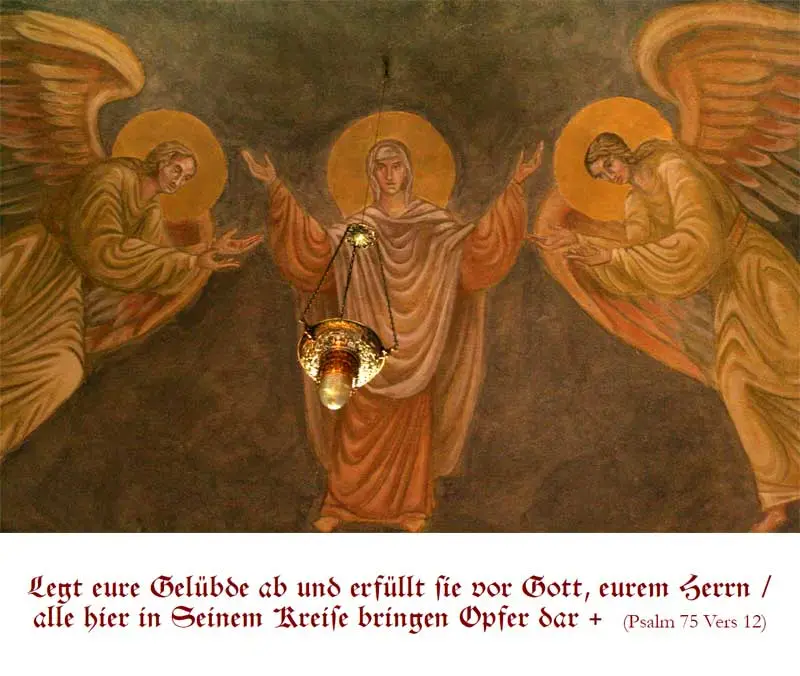
Holy Fellowship is not an earthly matter, but a mystery. It is grounded equally in the power of God and in the breakthrough of the called one to the Spirit. Monks, holy Tradition says, are angels in the body. Angels serve God in complete selflessness. They are bound to one another and to God, the eternal ground of being, in pure love and surrender. From Him, the All-Holy Trinity, the highest angels, Seraphim, Cherubim, and Thrones, receive supramaterial light and grace and breathe the breath from God. They are LOVE, KNOWLEDGE, and RESTING IN GOD. In blessed round dance they stand before the throne of God and sing the eternal “Holy, holy, holy”. Some glow in love, others behold in clearest knowledge, and in the third God rests, just as they rest in Him.
In deep love they turn to those beneath them and communicate to them, as perfectly as possible, what they themselves have received from above, insofar as those are able to receive it. The middle angels, dominions, powers, and authorities, govern the harmony of the universe, guide and lead the saints of the Church of God, and fight as commanders and mighty warriors against the powers of darkness. They are of surpassing beauty, hostile and inaccessible to every degrading bondage. Their rule never degenerates into tyranny, but is exalted above every alienation. It is full of goodness; it works freedom, self-becoming, and ascent. The angels of the lower choir, principalities, archangels, and angels, guide peoples and kinships as well as the God-consecrated fellowships, reveal promises and graces from God, and are in the fullest sense messengers of God. The angels disdain every compulsion, for they respect human freedom. (Cf. Dionysius the Areopagite, The Celestial Hierarchies.)
To enter, as a human being, “into the choir and community of the angels”, as the ritual of monastic tonsure says, would be impossible by human strength alone in view of this supra-earthly reality. But the grace of God gives strength to the one called. Our task is to hear the call of God and follow it. The path from earthly to angel-like being leads, in the language of myth, over a bridge thin as a hair and sharp as a sword. Only the pure lover, the wholly surrendered one, can cross it. For him it becomes wide and easy, and incorporeal angels guide him. Another image speaks of a “leap from the rock” and thus expresses the total offering in which the monk offers himself as a gift of love to God, the eternal, unknowable ground of being. To walk the path of the monks is not a matter of rational reasons, but is grounded more deeply, in eternity, in the heart of God and in the heart of the one called.
The overcoming of one’s own will, determined by sin, belongs to the most difficult requirements on the spiritual path. Only thus can the mystery of deification become reality. Therefore the fathers of the Holy Mountain Athos say that in obedience everything else is already contained. Obedience creates overcoming; overcoming brings purity, clarity, and love, and from these flow all beauty, goodness, and truth on earth. Spiritual obedience, in turn, comes from knowledge, love, and fidelity; it begins where divine longing finds its goal.
The holy Orthodox monk and Church Father Basil the Great (328-379 AD), in his descriptions of monasticism, praises especially the love and concord that reign among those consecrated to God. It causes the monastic community to live and act like a single body, or rather like one spirit in many bodies. This love and unanimity are grounded not in flesh, but in Spirit (cf. John I 12-13; Rom. VIII 9-11). They become possible when the individual overcomes his egoism, follows the elder like Christ in holy obedience, and gives himself wholly into the love of God (cf. John XV 1-17; 1 John II 7-11; IV 7-21). No one seeks his own; each serves the whole and strives to do good to the brother. Each is wholly oriented toward the triune God, the eternal ground of all being and all sanctification. (Cf. Basil the Great, Ascetical Instructions.)
The bond with the triune God finds its earthly correspondence in the bond with the concrete human community. God is faithful; therefore I too can be faithful. As in heaven, so on earth. The fidelity, love, and surrender of the individual find their support in the surrender, love, and fidelity of the elder and the brethren. It is a great tragedy when the surrender of a young person strikes the void of a hollowed-out traditionalism or is misused by false leaders or institutions. Wherever earthly power and greatness stand too much in the foreground, there is the danger that the Spirit withdraws. Therefore true monasticism does not strive to shine in powerful institutions or win the applause of the crowd, but first and in all things to please God and to ground itself wholly in Him. This of itself brings a certain withdrawal and solitude, for no one can serve two masters. Because true monks consciously renounce all earthly claims to power, they can, by reason of their spiritual freedom, purity, and immediacy to God, be spiritual counselors and guides of the believing people.
Just as the angels do not simply form “community”, at least not in the worldly sense of sociability or association for a purpose, but in hierarchical fellowship as liturgists, spiritual warriors, and servants of the eternal Kingdom in supra-earthly harmony awaken, foster, and defend the holy and sanctification in all things always; just as none seeks his own, but each becomes a radiance of the eternal primal light that unites all from the ineffable and beyond-being ground, and which each receives from above, so monastic community is best characterized by the term Holy Fellowship. The monk first establishes in himself the rule of the Holy, for that is what hierarchy means, by manfully cleansing himself of everything that is not God’s, and at the same time opening himself in holy readiness to receive the inflow of divine grace and power, divine light. But purification and illumination bring union in God. Thus he will attain divine wisdom. Therefore monasticism is also called the true philosophy; and this is meant not in the abstract doctrinal sense, but in the sense of life in love and truth.