



Elder Johannes, Orthodox Monasticism
by Elder Johannes of Buchhagen
History
From the beginnings of Christianity there have always been individuals filled with the love of God who, in complete devotion, consecrated their lives to the Holy and Eternal. In all the great cultures of the earth, monasticism plays a central role in the religious and spiritual life of society. The Bible tells of the prophet Elijah, his disciple Elisha, and the sons of the prophets; we also know of the mysterious Essenes, with whose circles the prophet John the Baptist, and even Jesus Himself, have been associated.
The archetype of Orthodox monasticism is the Evangelist John, the apostle of wisdom and mystical love of God. His Gospel, his letters, and the secret Revelation bear witness to his highest initiation and visionary power. One of the first historically tangible monastic figures is Saint Anthony the Great (250-356 AD). As a young man he followed the call of the Gospel, left his considerable wealth, and went to an elder, a hermit, as many lived at that time in the desert between the Nile and the Red Sea. After, in mature years, he had lived alone for a long time in a remote tomb without going mad, he became one of the most famous elders of Egypt. He became known through his Life, written by Athanasius, the bishop of Alexandria at that time.
When in the 4th century the persecution of the Church ended and Christianity slowly became the state religion, monasticism had already become a great movement. And when the Church, through its unimaginably growing power, came into danger of becoming worldly itself, it was above all monasticism that preserved the spirit of the origin and the mystical path of transformation that Christ had taught His disciples.
With great enthusiasm the holy Church Father Basil the Great (329-378 AD) writes in his works about the monasticism of his time. He is impressed that the monastic community unites people of the most varied origin and education in perfect holy love; he praises the unanimity, true freedom, and purity of heart that he observed in the monasteries.
Of outstanding importance is the holy teacher of the Church Gregory Palamas. He was highly educated in all secular and spiritual sciences when he became a monk on Athos in the 14th century. Because of his special abilities he was later elected archbishop of Thessaloniki. There, in the spiritual disputes with Western scholasticism, he reflected upon and defended the mystical practice of Orthodox monasticism. Not least thanks to him, mysticism and theology did not become opposites within Orthodox Christianity, and Orthodox monasticism was able to preserve its autonomous, prophetic, and charismatic character. In this connection he formulated the teaching on the divine energies, whose agreement with the tradition of the ancient Church was confirmed at the councils of 1351 and 1352 in Constantinople.
While in the 18th century the ideology of the Enlightenment in the West led to total secularization and materialism, Saint Paisius of Neamt and his many disciples recognized the hostility to the spirit hidden within it and, drawing on the living tradition of the Holy Mountain Athos, strengthened monasticism in Romania and Russia in its original spiritual breadth and wholeness, thus preserving Orthodoxy from sinking into rationalism and emotionalism.
Since the 1980s, Orthodox monasticism in Eastern Europe and Asia as a whole has experienced a new flowering. On the Holy Mountain Athos, to name only one example, Joseph the Hesychast lived as an elder; his disciples today serve as elders and abbots on Athos and throughout the world. Elder Ephraim alone founded 15 monasteries in the United States within 20 years.
These and other famous monastic fathers are only the historically visible high points of an infinitely wider spiritual brotherhood. Most Orthodox monks and elders work in silence. They flee all external honors and offices; many refuse ordination to the priesthood, and some even avoid having their name become known. Among them are gifted artists, architects, gardeners, musicians, highly intelligent and simple people alike. In the enchanting beauty of some monastery complexes and in spiritual culture, they leave their indelible traces.
The Monasticism of the Holy Mountain
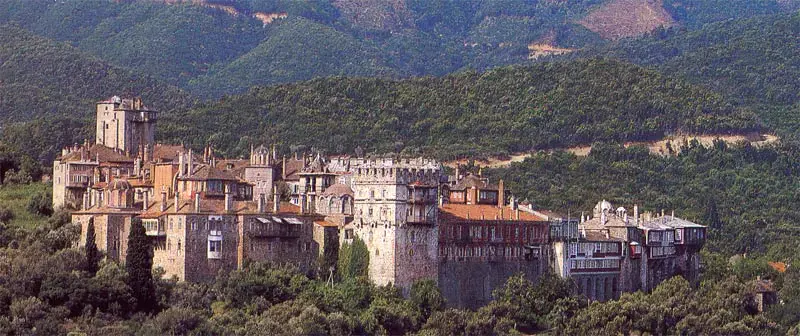
One of the most important centers of Orthodox monasticism today is the Holy Mountain Athos. Monastic life there reaches back to the beginnings of Christianity. Archaeological excavations recently brought to light, beneath the main church of Vatopedi, the foundations of an imposing earlier building from the time of Emperor Theodosius (4th century). Until the 9th century, the monks of the Holy Mountain lived in complete seclusion in relatively small communities or as hermits. Written reports are therefore sparse. Only Saint Athanasius the Athonite founded a great monastery after the model of the Stoudios Monastery in Constantinople and the Monastery of Saint Sabbas in Jerusalem. Finally, in the year 962 AD, the Holy Mountain became an autonomous monastic state with its own constitution. This guarantees freedom, political and ecclesiastical autonomy, and the diversity of monastic forms of life. Athos is thus the oldest republic still existing in the world today.
To this day, all forms of early monasticism can be found together on Athos: hermits dwelling in hidden forest huts and caves in the mountains; kellion monks living two or three together under the guidance of an elder on larger estates, that is, smaller monasteries; and the great monasteries with 20 to 100 monks and more. There are 20 “imperial and patriarchal arch-abbeys,” each of which governs a district of the monastic state and to which the small monasteries, hermitages, and monastic villages belong. Throughout history the monasteries could do without their own enclosure because the entire land is one single great enclosure. Until the 1970s it was very difficult to reach the Holy Mountain. Only modern development, with its convenient travel possibilities and the many hundreds of pilgrims who stream daily to the Holy Mountain, has recently made it necessary to protect monastic seclusion in other ways.
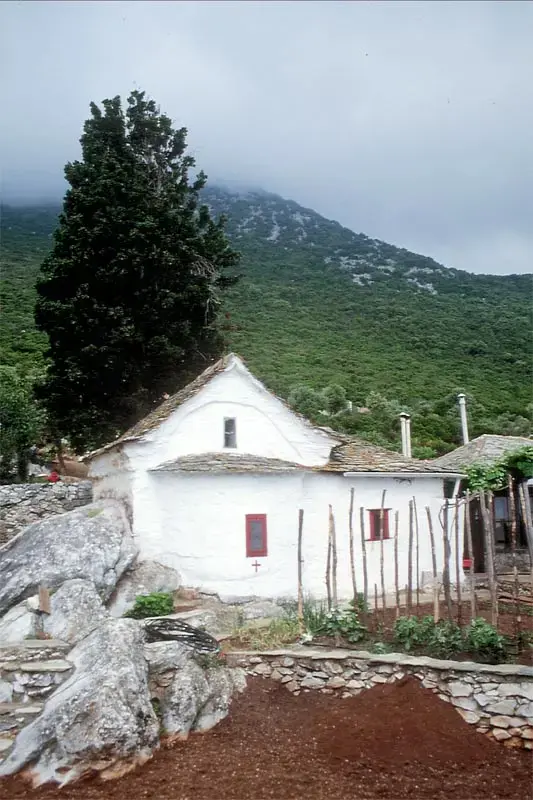
Athos was and is above all a refuge of living Christian mysticism. The Orthodox monks possess an ancient spiritual tradition that is unique in the Christian world. Athonite mysticism is called Hesychasm, from “hesychia,” silence, stillness. Here “theology” does not mean academic book knowledge, but the actual transformation of the heart, that unspeakable inner understanding and being seized which accompanies contact with God. A true theologian is therefore not someone who can display academic degrees, but one who carries the Logos, the Eternal Word of God, in the heart. In this sense, theologian means spirit-bearer, Christ-bearer, saint. “Theology” in this sense is, in essence, lived mysticism.
The monasticism of the Holy Mountain is not a mere form of life, not a “regulated life” that one could simply set up from books or according to corresponding prescriptions, but consists essentially in the handing on of that stream of tradition which can be mediated only through living human beings. This is also called “the living stream of grace."
From the Holy Mountain Athos, numerous monastic foundations have gone out to other countries in the course of history. These always took place spontaneously, guided by the Holy Spirit. There was never an attempt to create supraregional associations, like the orders of the Western Church. The connection of a new foundation to Athos is not organizational or juridical, but purely spiritual in nature and always personal. It exists through the handing on of the holy tradition and through the lines of elders, which in a sense form spiritual dynasties that can often be traced back for centuries. When a monk is called in the great S’chima and receives the blessing of his elder, which happens rarely enough, he goes and builds a new monastery. Thus the seed of the monasticism of the Holy Mountain is carried on. Where young people then gather locally and receive the seed, the holy plant blossoms and a new monastic tradition arises.
Often these foundations contributed to the spiritual renewal and enlivening of the churches in the world, and they were seedbeds of monasticism for many peoples. Thus the Monastery of the Holy Trinity in Buchhagen too is only one link in a long chain stretching across many centuries, countries, and peoples.
Holy Following
Every Orthodox monastery forms its own monastic family, a Holy Following. The monastic vows and the obedience of the individual are not directed toward offices or institutions, nor toward the place, but always toward concrete persons. If the elder should decide, for spiritual reasons, to change location, the entire brotherhood follows him. The community gives the individual security and shelter; conversely, every individual bears the community and the monastery in fidelity and holy obedience.
The elder is the head of the monastic community. In the elder, the monk sees the presence of God; the elder is, according to a saying of Elder Joseph of Vatopedi, “image and place of the Eternal Word of God,” or also “place and manner of God.” This means that Christ, the incarnate God, becomes concrete in the elder and gains a place in the reality of life. The elder does not put himself in God’s place; rather, he “lends God his body,” giving God, through his devotion, love, and sanctification, a concrete “place” in the world. In this sense Paul said: “It is no longer I who live, but Christ lives in me.” And in the Psalms it is said that God “rests in His saints” or “is present in His saints.” The elder is a living icon of Christ. Elder Ephraim of Katounakia said: “Have you gladdened your elder? Truly I say to you, you have gladdened God.” The attitude of love, service, receptivity to holy instruction, reverence and humility, devotion and personal fidelity, makes the genuine spiritual disciple. In the perfection of this attitude in life, however, spiritual fatherhood in turn grows forth.
The Mystery of the S’chima - Secret of the Form
Every elder of the Holy Mountain has the experience and the consecration of the Great Holy Angelic Form (), and no one can bestow this consecration except an elder who has himself received it from his elder. And without this consecration no one can become a spiritual father for monks or the superior of a monastery - such is the ancient tradition. Outside the Holy Mountain this connection has at times been dissolved, often to the detriment of monasticism.
From God, among all elders, it is one and the same Holy S’chima, and yet every monastic family has its particularity, its unmistakable face. Orthodox monasticism is not uniform, but rather brings forth a fullness of living forms, just as no oak is completely like another, though all oaks are one according to kind and genus. This principle is also fundamental within the individual monastic community. Every human being is different, and we do not want standardization. Rather, the divine archetype in the human being should blossom and the person should mature into the form most proper to him. Precisely in the difference of characters, the fathers of a following can wonderfully complement one another. The following is much more than the sum of the individuals. Community becomes an organic reality of its own, whose unifying power is divine love and devotion to Christ and to one another. Thus the monastery forms a perfect Church in miniature.
What is the secret of the monastic S’chima? In what does the sanctifying mystery common to all consist, amid all the differences of personality?
In the Bible, in the book of Genesis, it says: “God created man as His image (kat eikonan) and unto His likeness (kat omoiosin).” Every human being is the image of God. But likeness to the eternal archetype, ultimately to God, must first be acquired and realized in the course of our earthly life, and indeed in each person’s ownmost form, according to inner necessity. To the degree that this succeeds - which is possible only through divine grace - to that degree the human being becomes holy. This spiritual anthropology differs both from the modern Western idea of individuality and from the Eastern idea of depersonalization. In traditional monasticism the personality is not erased, but transformed and anchored in transcendence - the transcendence that is already laid within us. The essence of the human being, as God intends it, is cleansed of all overlays of the external, accidental, and conditioned; what is essential, the spiritual core, comes forth and gains dominion over the outer and lower aspects. Thus the spiritual form, the original beauty of the divine image in the individual human being, grows. The further this becoming-form advances, the more the divine reality that surpasses the merely earthly enters life through the human being and in him, and becomes experienceable. Therefore it is said: “God meets us in His saints.” Where the human being attains this, where he unfolds and realizes the divine archetype placed within him, he gains the “perfect and ownmost essential form.” This is the secret of the Holy S’chima, of the Holy Form.
Orthodox anthropology has deep knowledge and very clear concepts of the powers and givens that form what in German we call “Gestalt,” or, in Latinized form, “personality” (Gr.: Hypostasis). To present this here would exceed the scope of this sketch-like introduction. In any case, the secret of monasticism is, at its core, the mystery of God Himself. The mystical path unites opposites: obedience and strength of will, wisdom and childlikeness, simplicity and depth, humility and dignity, zeal and serenity, solitude and community, masculinity and femininity, bond and freedom, greatness and lowliness …
Ascesis and Freedom
The so-called Gnostics, that is, knowers, teach that spirit and body stand hostile to one another. True gnosis, however, as it takes shape in Orthodox Christian experience, teaches that the body is not an enemy of the soul but its faithful servant - provided only that the hierarchy of things, the inner rule, is rightly ordered. The bodily, sensory world can be a mirror of the spiritual. Therefore all that is bodily is indeed included in monastic ascesis, but is not rejected or fundamentally denied. There is hardly any divine service more sensory and at the same time more spiritual, more otherworldly, than that in an Orthodox monastery. Orthodox asceticism, like the whole Church, rests on the mystery of the incarnation of God and aims at the renewal and sanctification of life.
The falsifications of life, however, the fallen world and its deception, are rejected all the more decisively. Therefore the first spiritual exercises consist in overcoming error and mastering the passions, both of which bind us equally to the fallen world. From this ascetic approach, Orthodoxy receives a dimension extending far beyond mere confession and religious or national identity. Only when all deception and all spiritual error have been overcome does Orthodoxy shine forth. Therefore, for the monk, Orthodoxy is much more than external church affiliation. It is the agreement of life, faith, and striving with eternal truth, of earthly being with the thoughts of God, perfect harmony with God, the primal ground of being - yes, in fact, the immediate radiance of God, as the word itself says. The Greek Doxa in our context does not mean “opinion,” as in the language of ancient Greek philosophy, but rather “radiance, honor, beauty.” Orthos here means “upright, straight, clear, bright.” Thus Orthodox does not in the first place mean “right-believing” in the sense of confessional classification, but rather “rightly glorifying” or “illumined by the immediate radiance of God.” Whoever receives the radiance from God and thus awakens spiritually also cleanses the disposition and thoughts. And because he sees and senses in the heart what is essential, the radiance from God, he knows the conditionality of all merely conceptual, rational ideas and all merely emotional sensitivities. Because he knows the archetype, he can distinguish the value and meaning of the images. Thus he is protected from error by the light of God itself.
One day students came into the desert and wanted to put one of the elders to the test. They said: “Are you Agathon, of whom we heard that you are a fornicator and a proud man?” But he answered: “Yes, I am.” “You are Agathon, the chatterer, glutton, and drunkard?” And again he answered: “Yes, I am.” Then they said: “Are you Agathon the heretic?” He answered: “No, I am not a heretic, but Orthodox.” Astonished, they asked him: “How are we to understand this? We said the greatest insults to you, and you denied yourself and accepted them; but the final accusation you will not let rest upon you?” Then he explained to them: “Heresy, spiritual error, is separation from God, for God is truth. But I do not wish to be separated from God in the least.” When the students heard this, they went away from him, both ashamed and edified.
The “normal” world is fallen through separation from God, in an existential sense. Some know the feeling that this normal life cannot be what is essential. While a young person still feels the falsifications of life intensely, most soon begin to suppress, to numb themselves, and somehow to “go along.” Often it is indirect compulsion, or fear of becoming an outsider, fear of losing the love and recognition of friends or of society in general. Usually it is simply ignorance, the lack of credible alternatives. But it is always a dangerous spiritual weakness. The “prince of this world” does not want us to awaken and recognize truth. Many a genuine calling is blocked under the pressure of “normality”; advertising, films, media, the mechanisms of dependence and consumption, in short, all kinds of worldly influences do the rest to ruin our innermost perception permanently. For the monk it is therefore absolutely necessary to see through the deception of the fallen world and at the same time to strengthen the connection to eternity, to God, and to His saints.
Because we are born into this world of falsifications and deceptions and must inherit, without being asked, the burden of separation, of fundamental estrangement, the “guilt of Adam,” the guilt of our fathers, tradition speaks of “original sin.” This estranged life, with its apparent pleasures and necessities, continues to falsify our living relationships with one another, prevents the knowledge of God, and makes the unfolding of the inner human being toward the realization of his eternal divine archetype almost impossible - at least by one’s own strength.
All these “inauthenticities” we call “fetters of carnality.” The essence of these fetters of carnality is deception; deception, however, is a spiritual principle. Therefore the Gospel says that every sin can be forgiven, only the sin against the Spirit cannot be forgiven, for the Spirit of God is light and truth and purity. Deception is contrary to the Spirit of God; it is the spirit of the Antichrist.
The monk gives a clear refusal to this betrayal of love and truth, to the falsifications of life. The insight that there can be no true life in falsehood is an essential motive of the monastic calling. Yet it does not lead to despair, disgust, or hatred, as in existentialism or nihilism, but to an existential breakthrough that breaks open the conditionedness of human thinking and human representations. The search for what is essential presses forward to the mystery of life itself, where it coincides with the mystery of God.
The practical questions - how to renounce the falsifications? How to realize love and truth? - are answered pragmatically. A first answer is: freedom. The more independent one is of all deception and error, of consumer and career thinking, of external norms, of everything which, if not false, is nevertheless provisional and inauthentic, the greater the chance of pressing through to truth and to essential being. Here negative ascesis begins, aiming at the reduction of external needs and detachment from old dependencies and fixations. Yet to break deception sustainably and unfold the archetype, there are no stronger tools than love and obedience. In the traditional spiritual schooling of Athos, obedience and love are therefore regarded as the very pillars of the mystical path. A second answer arises from the experience of a beauty anchored in the truth of God. It is no accident that the creation of sacred art is very widespread in Orthodox monasticism. Here begins the realm of positive ascesis. A third answer finally lies in the brotherly community of love, the attitude of service and attentiveness, in human friendship, love, and fidelity. Singing, ritual, and the liturgical shaping of the whole living environment also belong to positive ascesis, which aims at the purification of all aspects of existence and their illumination with divine being.
Reception and Transformation
Both negative and positive ascesis presuppose a third thing if they are not, in the end, to become merely arrangements within the world. This third thing is that mysterious “jot” in the law which must by no means be removed (Matt. V, 18; Luke XVI, 17): the breath from God, the inflowing of the Spirit of God. We experience it in the practical exercise of spiritual prayer. Spiritual prayer is not a request for something, nor even intercession, but pure, “purposeless” adoration before the face of God. It is a matter of spiritual readiness to receive, beyond thinking and emotional movement. In the moment of perfected purity, divine love and wisdom recognize themselves in the mirror of the human spirit. The exercise of this attitude forms the basis of Hesychasm. From this attitude, life and all doing and refraining gain their anchoring in eternity. And only through this otherworldly dimension does Orthodox monasticism become a spiritual power.
The regular practice of the well-known Jesus Prayer, “Lord Jesus Christ, Son of God, have mercy on me,” is a central element of exercise on this path, embedded in the sanctified context of life and in the common liturgical worship of the Church.
The mystical path can in no way be reduced to special teachings and systems, neither to any ideology nor to this or that “technique.” Rather, it is hidden solely and entirely in the right manner of life that recognizes itself in God Himself. The path is the unfolding mystical experience of being - the life of sanctification as reflection and continual temporal realization of the incarnation of God in His saints.
The alpha and omega of the path are love and truth. Love and truth are the highest values of Christianity; without them, spirituality and ascesis are hollow and contrary to God. For love and truth are not merely temporal ethical and religious values, but eternal divine primal principles, powers of grace, or energies. God is love, as John the Evangelist says.
The realization of love and truth presupposes self-knowledge and transformation. To live them from the archetype requires a process lasting many years of growing into a corresponding attitude toward life and awakening to spiritual consciousness. When Christ speaks of “watchfulness,” this wider dimension is always meant. Love as a moral demand is doomed to fail. Love as ontological participation in the being of God, however, is the fruit of transformation. As such it has all-conquering power.
Monastic ascesis is, at its core, exercise of the heart. Light and darkness must be perceived and endured. To strip off everything false, to transform what is imperfect, and again and again to press through to what is essential, not allowing oneself to be confused by setbacks and failure: this is exercise of the heart. Thus the monastic form matures.
The mirror of the Divine lies hidden in the abysses of the heart.
The heart is the seat of the spirit, of spiritual perception. This must not be confused with the external intellect, nor with the realm of feeling. Thought-power and feeling are important functions of the carnal human being. But the spirit of which we speak here, Greek “vous,” does not belong to our earthly, mortal nature, but to our spiritual, immortal, eternal nature. The spirit of which we speak is breath from God (cf. Genesis I). We have it in common with the angels; through it we perceive spiritual realities, through it we pray, through it we commune with God and the saints in eternity and in time.
Consciousness must be distinguished from this. Consciousness is what we know at a given time. Therefore consciousness is not a capacity, not an ontological reality, but a conditioned, composite, fleeting magnitude, formed, fostered, or impaired by spiritual as well as carnal, bodily, emotional, and mental influences. It is perceiving, understanding, and knowing itself - but not the one who perceives, and not what is perceived. Depending on whether it is anchored in certain thoughts, or in feelings, or in the spirit, that is, depending on whence it is formed, the human being experiences a different perception, as well as self-perception. Therefore it belongs essentially to the spiritual path to orient consciousness toward the spirit and then, from there, to illuminate all other areas of being.
In practice these connections have been known for millennia, at least in the living traditions. Whoever approaches the mystery of God must let go of all external thoughts and representations and overcome inhibiting emotional dependencies and inclinations. Not because thoughts or feelings are bad or forbidden in themselves, but in order to reach the deeper, finer, spiritual perceptions. An ascetically purified disposition and an intellect that has come to rest no longer disturb spiritual perception, but even become a good tool of the spirit. For where the spirit has awakened, feelings, thoughts, and consciousness also change.
Purity and Grace
Where we overcome vanity, egocentricity, hypocrisy, and false piety, and also grasp the nothingness of rational concepts and constructions, we gain inner freedom. Through attentiveness, obedience, and love, spiritual perception and power develop. Where the practitioner refines his spirit and his spiritual receptivity, he regains the original purity of heart lost in the world of falsifications. In this purity we receive divine grace.
The grace of God comes to meet human effort. Right ascesis opens us to the reception of grace by purifying us and leading our spirit to fruitfulness. Where the senses of the human being are purified and love has become strong through devotion and trials, the grace and power of the Holy Spirit stream powerfully into the heart. There it dwells in our spirit, stills its desire, and drives out its blindness through holy illumination. Thus it brings us to the flowering of spiritual clarity.
The experience of grace surpasses every concept. Illumination is described as the reception of the Tabor light, that otherworldly, divine light which the apostles John, Peter, and James also saw on Mount Tabor. Grace can also pour quietly and gradually into the heart and express itself more indirectly. In every case, however, it changes the human being, makes him different: wide, luminous, and beautiful.
On purity Saint Gregory Palamas writes: “Purity is a state in which, above the spirit during prayer, the light of the Holy Trinity shines, and in this state the spirit passes even beyond what is commonly understood by prayer. Indeed, this can hardly still be called prayer in the usual sense, but rather a fruit of pure prayer, which is always conceived by the Holy Spirit. The spirit then no longer prays in external prayer, but goes beyond itself (‘in ecstasy’) to things no longer graspable. This is that holy unknowing which is higher than all knowledge. In a purified heart the spirit stands before God without form, pre-formally, without claim and representation, and is thus able to receive the immediate impressions of the divine archetypes, whose mirror it becomes."
Purity is here understood as the highest state of spiritual prayer. The vision of the archetypes is insight into the divine thoughts. Elsewhere there is talk of the vision of the Tabor light, of the uncreated light, the divine energies. The spirit of the human being becomes a mirror of the divine thoughts that are “imprinted” upon it. Here again an ontological transformation is indicated, a process that changes the being of the human being and makes him a bearer of divine powers and effects.
Purity is also an attitude of the soul, indeed of the whole life. Purity in human relationships, purity in devotion, in love. It is not the case that one must first have attained purity in all areas of life in order to come to pure prayer. This is grace, as is that. Conversely, the practice of pure prayer can gradually illuminate all other areas of life and lead the practitioner to purity. But it is always a matter of purity of heart. The heart becomes the eucharistic chalice, the Holy Grail, the vessel of divine life. It must be pure and clear before the divine Word can take up dwelling there. In the mystical encounter and union of these two, the deepest point of the heart becomes the mirror of God. I then say: divine wisdom recognizes and begets the Eternal Word, and both are at once one and unmixed and perfect, for there is no longer any thought. This is purity.
A decisive key to purity is devotion - the sacrifice offered in freedom and out of love and for the sake of love. We give what is perishable and receive what is imperishable.
The Divine Eros
The only power that truly makes such a sacrifice possible is the divine eros. With this, at first sight unexpected, term, holy tradition designates that pure power of divine love which has brought forth the universe and all creation, that divine primal power from which all that exists lives, which with the breath of God (Gen. I) has also been placed in us, and which leads us to the knowledge of truth. It is the all-embracing love of the primordial eternal God Himself, of which all earthly loving, striving, and goodwill are only a faint reflection. In the Gospel and in the Divine Names of Saint Dionysius this power is simply called “love.” Be that as it may, the divine eros kindles a holy desire, opens the spiritual eye, leads to knowledge of the true, highest possible essential form, and unfolds our reality of life toward the divine archetype. Between human beings it produces a pure inclination of the heart, in which there is nothing impure, no fear, and no selfish willing. The longing for love and truth, laid within every human being and so often wounded or even destroyed, is image and echo of this highest striving. No earthly love can fulfill this longing unless it selflessly submits to that highest archetype and origin of itself.
God does not force Himself upon us, but He knows our longing. He Himself has placed longing in our heart so that we may seek Him and receive the strength, for the sake of this search, to leave other things behind. Thus the lower gives way to the higher, without the lower being condemned or denied; it falls away like dead skin because something new and higher comes and draws our striving for love to itself. The provisional, the inauthentic, gives way to the essential; the image is absorbed by the power of the archetype.
In the world, our longing is usually diverted by the falsifications of life toward unsuitable, inauthentic goals. We are cheated of what is essential and hindered from receiving grace by being overwhelmed with substitutes and falsifications. Our own unripe feelings and thoughts make us additionally susceptible to such deception.
The source of all longing is at the same time the source of all fulfillment. From the divine eros, the creative love of God, spring all life-force, all creativity, all genuine love and friendship. Every noble, pure striving of the human being is image and mirror of the divine eros. Thus God has known us; thus He wills to be known by us, so that we too may know one another in truth.
Monasticism is perhaps not the only, but in any case the most extreme and unconditional answer of a human being to divine love. Here the desire of the human being and the desire of God come together completely. Real monasticism, which at its core is always the becoming-form of divine love, resists every narrowness of spirit and outlook. For this reason a community of scholars, theologians, or priests is not yet a monastery, not a Holy Following in our sense. The Holy Following is a holy bond of God-consecrated mystics and of those who are on the way there, who desire the true life. Its telos is the perfection of love.
Prayer in the Monastery
Liturgical prayer is held by all monks together in the temple. These are the anciently transmitted liturgies of the monastic cycle of daily offices: Vespers, Compline, Midnight Office, Orthros, the Little Hours, and the Divine Liturgy. In addition there are special services on the high feasts of the Church and according to the local tradition of the monastery, such as blessings of water, blessings of the land, the house, and the gardens. The liturgical services of the Orthodox Church are ancient. In part they go back to the services of the Jewish Temple and synagogue, to which Christian elements were added, such as Vespers; ancient mystery experience has also entered in. The final redaction of the Divine Liturgy was undertaken around 400 AD by the holy Church Father John Chrysostom. Here the liturgical conservatism of Orthodoxy is especially evident. The divine service is an image and participation in the heavenly divine service, which the highest angels offer unceasingly at the throne of God.
Independently of the liturgical services, every monk personally practices spiritual prayer. In the hours of silence, to which great value is attached in the monastery, at midday, in the evening, and early in the morning, the individual monk has time and space for this. Overall the aim is to fulfill the word of the apostle, who says: “Pray without ceasing.” The times between the liturgical services are filled with the prayer of the heart: “Lord Jesus Christ, Son of God, have mercy on me.” Depending on the spiritual level the monk has attained with regard to purity, fidelity, and the virtues, this prayer even continues in sleep, and of course it is prayed during work and at every time. There are special exercises for deepening and anchoring the prayer, whose goal is to become pure spiritual prayer. At this level prayer permeates every activity of the monk and also permeates and raises the liturgical prayer of the community to the level of spiritual adoration in the properly mystical sense.
In this connection, spiritual readings and instructions should also be mentioned. Prayer is connection with the Eternal Word, the incarnate God. Where it becomes spiritual prayer, it leads to the grace-filled vision of the archetypes, to the reception of the divine thoughts, indeed of the Eternal Word Himself. Thus the holy fathers became bearers of the Eternal Word. The words and instructions of the fathers in turn are the seed of the same eternally unspeakable Word which wants to take form in the monk. The works of Saint Basil the Great, Gregory of Nyssa and Gregory the Theologian, Saint Dionysius the Areopagite, John of Damascus, Saint John of Sinai, Symeon the New Theologian, the Philokalia, and many other writings, together with the spiritual instructions of the living elder, are spiritual nourishment and fructification from which the prayer life of the monk is inspired and deepened. Through the living word the monk is begotten in the Eternal. It is clear that living spiritual instruction is not merely a matter of moral teaching or intellectual accumulation of knowledge, but rather of opening and internalizing the meaning of the holy Scriptures. The spirit-bearing instruction of the elder can be described as spiritual communion, which lays the seed of the divine Word into the heart of the prepared one and unfolds it.
Work in the Monastery
Every work in the monastery is at the same time a field of exercise and is regarded as holy service and spiritual exercise. Steady bodily activities are especially favorable to spiritual prayer; yet every work has its own ascetic value, not least artistic work. The fields of work in the monastery are very varied. In first place stands liturgical service. The services are sung and recited throughout, which presupposes in each individual a thorough training in the corresponding disciplines. But garden, household, kitchen, pastoral care for the faithful and guests, nursing of the sick, landscape work, icon painting, construction work, and translation work are just as important.
Spiritual life requires autonomy. Inner autonomy arises through the dissolution of the fetters of carnality and through spiritual consciousness. The essential basis of external autonomy is economic independence. Any form of support from outside leads, sooner or later, to spiritual dependence. In the monastery the cost of living can be kept low; nevertheless prudent management is necessary. Building and preserving the sanctuary, together with the furnishing and operation of the temple, require the procurement of corresponding financial means even with a Spartan basic attitude. Since today we live in a secularist society tending toward anti-Christianity, there is almost no social support. Activities for earning a livelihood are therefore indispensable. It is necessary to pay strict attention to what is compatible with the monastic ethos and what is not; above all, the basic spiritual orientation must not be endangered by so-called practical constraints. This requires imagination and active strength. Ideally the monks work only within the monastery. Because a great deal of unpaid work is done, which in turn benefits society as a whole, the monastery may accept donations.
The work in the monastery is divided into so-called “services.” In smaller monasteries the services are assigned by the abbot; in larger monasteries they are assigned by the council of elders according to the necessities of the community. The abilities of the individual are taken into account and fostered, while spiritual considerations also always play a role.
The following describes the circumstances in a large monastery, such as Megisti Lavra or Vatopedi on the Holy Mountain Athos. Foundational for the community is the elder. As spiritual father of the monks and head of the following, he is also abbot of the monastery. The instruction of the novices is his responsibility; if there are many, he appoints other elders, always monks in the great S’chima, for this task. All fathers are bound to him in personal fidelity and obedience. His main task is directed inward; the care and spiritual guidance of the fathers are his responsibility. In addition, he represents the community outwardly toward state and other social institutions. The steward (Epitrop) manages the administration and economy of the monastery and sees to the necessary purchases; he is also responsible for tools, machines, and vehicles, for supervision of the food stores, and for possible construction and renovation measures. The secretary handles correspondence, issues documents if necessary, keeps the current schedule and the monastery chronicle. The librarian orders and cares for the library; he ensures that the necessary books are acquired, that the existing ones are carefully cataloged and preserved, and that all can use them at any time. The gardener is responsible for the monastery garden and orchards, which is very important for the community’s food supply; other monks are assigned to assist him. Sometimes there is a separate service for the care of the outer grounds of the sanctuary, including trimming hedges and maintaining paths. The guest father sees to linen and cleanliness in the guest area, receives and cares for the guests; the cook and refectorian (Trapezaris) provide the daily meals. The refectorian is also responsible for cleanliness and order in dining room and kitchen. Priests and deacons are assigned to weekly service; this includes carrying out the holy services together with the singers and readers. The priests also take on pastoral work outside, such as confessions and conversations with spiritual disciples and pilgrims; in addition, they usually have other services. The typikaris has oversight of the order of the services and the selection of liturgical texts; he currently assigns singers and readers. The typikaris instructs the novices in liturgics and Church history. Every monk is in principle singer and reader. The weekly reading service is assigned together with priestly and diaconal service. In principle, however, every monk can be called into the choir at any time by the typikaris. The ecclesiarch cares for candles and oil lamps in the temple; in the course of the services he must light and extinguish them according to the holy order; he is responsible for the cleaning, care, and readiness of the temple as a whole. Removing wax stains from the church floor and maintaining the candlestands is work not to be underestimated. Since in large monasteries, besides the main temple (katholikon), there are many side churches (parekklesies), all of which must be kept in operation, there are sometimes several ecclesiarchs responsible for the additional sacred spaces. Additional monks are assigned to the ecclesiarch as assistants, the temple servants (Ekklesiasten), who perform both practical and liturgical services in the temple. The cleanliness of the common rooms, sanitary facilities, and corridors in the enclosure is the responsibility of novices and younger monks, but in principle everyone is at some time assigned to cleaning service. Every monk must in any case keep his own cell in order; there is no special service for this. The caretaker is responsible for all smaller repairs to the buildings and for operation of the heating; this also includes storing firewood and cleaning the stoves in summer. The abbey father (Igumeniaris), on behalf of the abbot, calls the council of elders (synaxis) and other assemblies of the monks; he receives official visitors and serves in the synodikon at receptions and spiritual instructions. In large monasteries there is also an infirmary with an infirmarian, sometimes even physicians. In addition there are the services in the workshops. Orthodox monasteries usually have a workshop for icon painting or woodcarving, a tailor shop for making monastic clothing, and beekeeping - incidentally more for producing wax than honey - and perhaps a carpentry shop.
Monastic Tonsure
According to the original Orthodox tradition, monastic tonsure is a sacrament, a divine gift of grace, like baptism, priestly ordination, or the Eucharist. There is only one mystery of monasticism, yet there are three degrees of tonsure, corresponding to certain stages in the unfolding of the Holy Form.
1.) the tonsure of the Holy Garment (Ράσοευχή),
2.) the tonsure of the Little Form (Μικρόσχημα), and finally
3.) the tonsure of the Great Holy Angelic Form (Ἅγιο Μεγάλο καὶ Ἀγγελικὸ Σχῆμα).
The tonsure of the Holy Garment (Ράσοευχή) is already a fully valid monastic tonsure and should be bestowed only after a corresponding period of trial. It presupposes the eternal vows and monastic way of life and is performed in connection with a night vigil. It corresponds to the state of the apprentice who has made a clear decision and walks the way of the monks with seriousness, but is still at the beginning. There are monks who remain in this state throughout their lives and become holy men through obedience, humility, and selfless service. From the beginning the monk, as an “angel in the body” and “messenger of God on earth,” is placed in the eschatological struggle of the spiritual powers of which the holy apostle Paul speaks (Eph. VI, 12). The garment has strong symbolic significance; in biblical tradition it stands for the bodily side of the human being. In it, however, his spiritual attitude is expressed at the same time; even more, in its veiling it shows the essence.
The tonsure of the Little Form (Μικρόσχημα) is the second degree. The rite of tonsure is more extensive and embedded in the Divine Liturgy. In addition to the Holy Garment, the monk now receives the breastplate (Pallium). Thus he is distinguished as a spiritual warrior; his breastplate bears the cross of Jesus Christ as coat of arms and sign of victory. This tonsure allows the archetype to stand forth more sharply and should be bestowed only on one who can also endure and radiate such sharpness. A monk of the Little Form must maintain essential areas of monastic life independently and be firmly established in holy tradition - as in an old craft, a good journeyman understands his craft and is able to work independently.
Finally, the tonsure of the Great Holy Angelic Form (Ἅγιο Μεγάλο καὶ Ἀγγελικὸ Σχῆμα), as it is fully called, marks mastery. It forms the highest degree of tonsure. The monk receives the complete armor, the great pallium, which is worn like a priestly stole and on which further holy signs are affixed, as well as the cross-band (Polystaurion). This tonsure is given only to experienced monks who are wholly at home in the holy tradition and are able to guide and train other monks. According to ancient tradition, only a monk in the great S’chima can tonsure and lead other monks. All elders and abbots of the Holy Mountain Athos possess this consecration, and without it, that is, of course, without the spiritual reality, discernment, and experience presupposed by it, no one can lead other monks. Thus monasticism is prevented from hardening into abstract ideology and external rule-following. And it is ensured that the anciently transmitted forms are filled and borne by the living spirit, that the proper original character of monasticism as mystery and path of deification is preserved and carried on. Only where this whole breadth and depth of holy tradition truly lives and is given can one rightly speak of the “eternal stream of grace."
In this connection it should be mentioned that the term “lay monk” is entirely inappropriate in Orthodoxy. The distinction between “fathers” (Patres) and “brothers” (Fratres), that is, between learned priest-monks and uneducated working monks, is a special tradition of the Latin West from the time of feudalism and has never had validity in Orthodoxy. If one considers only the weight of the total sacrifice of life that every monk in principle offers, it becomes clear how problematic and ultimately discriminatory such distinctions are in the matter itself. On the Holy Mountain there are many holy elders who, out of monastic ethos, have never accepted priestly ordination; nevertheless they are spiritual fathers and guides of many monks and priests, indeed of bishops and patriarchs. Every Orthodox monk who, after a corresponding period of instruction and trial, has received monastic tonsure from his elder is therefore addressed as “venerable father.” Priestly and diaconal ordinations are received only by as many monks as are actually required for carrying out the liturgical services. Rank in the clergy has no influence on rank within the monastery.
It is clear that in smaller communities several services are combined. The smaller the monastery, the broader the field of activity of the individual.
Internal Structures of an Orthodox Monastery
As elder of the monks, the abbot is the head of the monastic community. He is elected by the monks of the monastery for life. The abbots of the larger monasteries, especially of the stauropegial, patriarchal, and imperial arch-abbeys, are always priests at the same time and receive the title “archimandrite”; thus in the ecclesiastical clergy they occupy the highest rank after the bishops. With regard to jurisdictional rights, they are equal to bishops within the monastery, although of course they cannot perform priestly ordinations. Yet there are also monasteries that do not possess such independence; this depends greatly on the monastic statute and local circumstances. On the Holy Mountain Athos even the smaller monasteries, that is, kellia and hermitages, enjoy an archaic autonomy guaranteed by the respective great monastery. The superior of such a community is often not even a priest, and some do not wish to become one. It is indispensable, however, that he have the tonsure of the great S’chima and truly be elder of the monks. Some want to see in this an antinomy between episcopal secular clergy and monasticism. There have been and still are conflicts and encroachments here and there; yet such things contradict both the monastic and the episcopal ethos of Orthodoxy.
The council of elders, the so-called synaxis, consists of all fathers in the great S’chima; if there are many monks of the Great Form, it is a selection of the oldest and most experienced among them. These are sometimes also priests, but not necessarily. The elders serve, alongside the abbot and on his behalf, as spiritual fathers for younger monks and also outwardly, that is, for the spiritual disciples of the monastery and for pilgrims. The council of elders is also an advisory body and internal spiritual court.
The brotherhood as a whole, the convent, is the community of all monks of the monastery; it is the actual legal body of the monastery and owner of the monastic property. The abbot always presides.
The epitropy is the monastic administration. The epitrop, in German Kämmerer, is a monk appointed by the abbot who possesses the corresponding business and administrative abilities.