Relics
As we commemorate all the saints, another heaven shines forth /
In the midst is the Anointed Himself as the sun /
as the moon in bright splendour the All-Holy / the eternal Mother and Virgin Mary ☩
And all the saints surround her in holy circles like the stars ☩
Therefore all the faithful / who fulfil this feast with heart and spirit /
will shine in eternity ☩
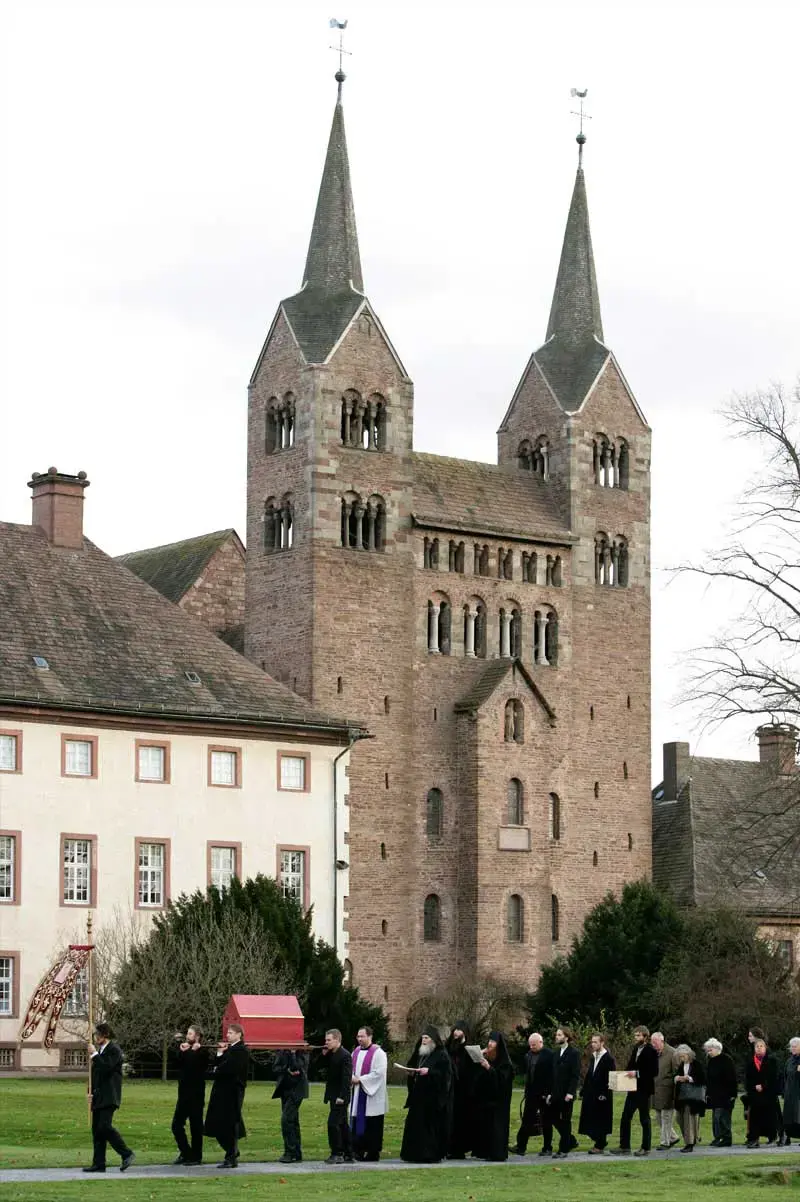
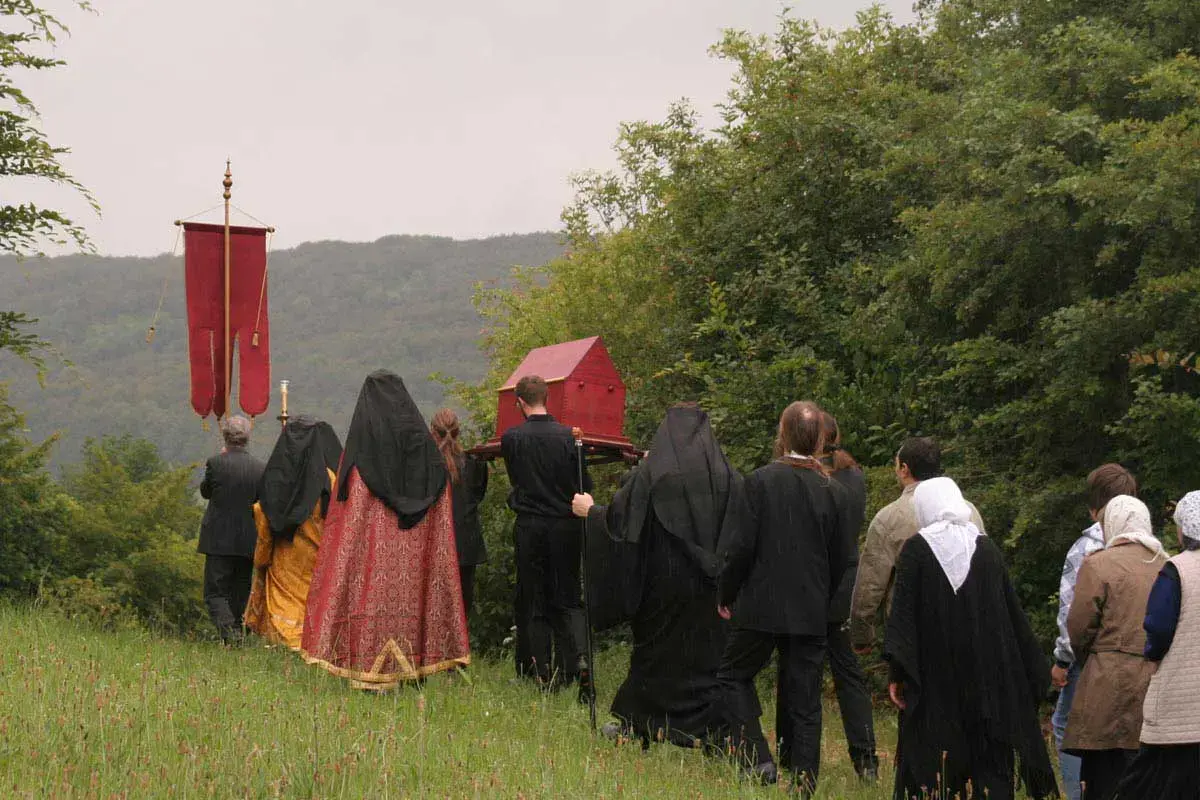
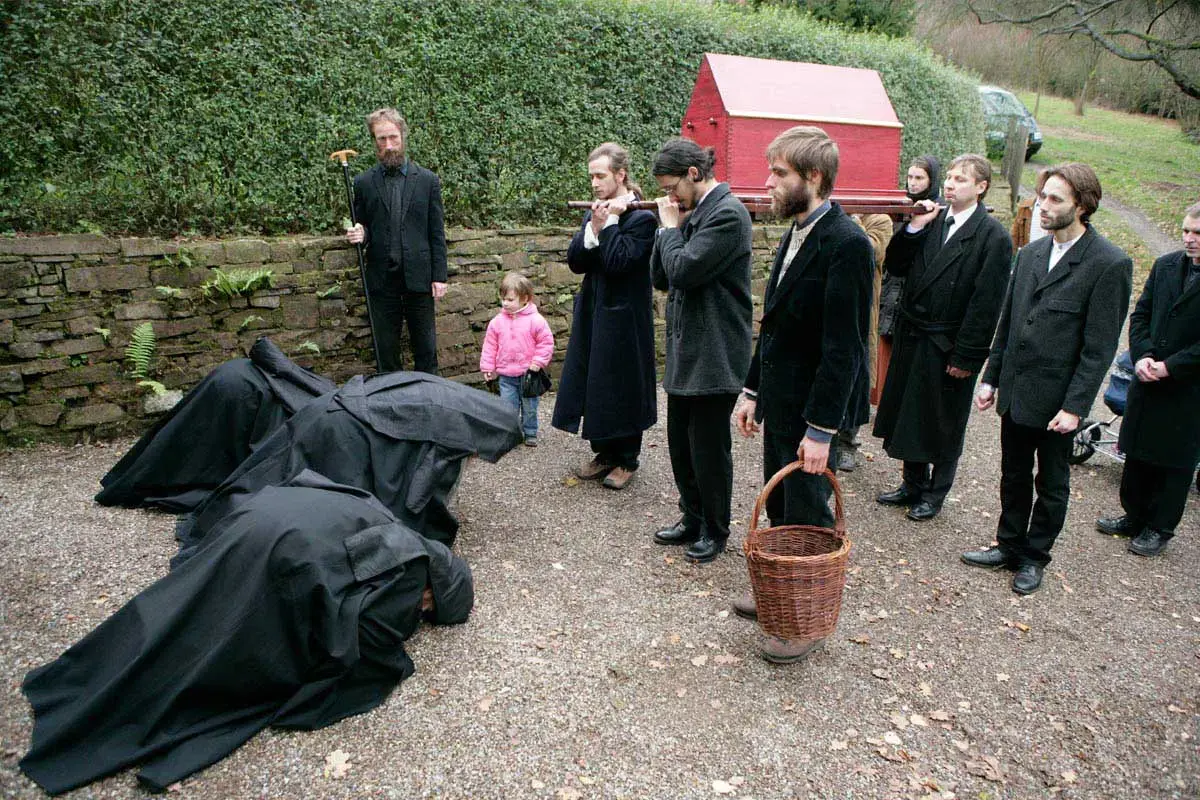
The relics of several saints are kept in the monastery as great spiritual treasures. On the feast day of one of these saints, toward the end of the morning service, the shrine with the saint’s holy remains is carried from the Holy of Holies into the inner sanctuary and is liturgically venerated by the fathers and the faithful present. On the feast of All Saints (the Sunday after Pentecost), all relics are already venerated at vespers on the eve, and after the Divine Liturgy a procession with the shrine of All Saints takes place around the sanctuary.
From friendly Orthodox monasteries come the relics of St Columban, the monastic father, of St Vitus the martyr and of St Auxentios the priest-martyr, of St Charalampos the martyr and wonderworker, as well as of the Romanian new martyrs of the twentieth century. By divine providence, in the Year of Our Lord 2006 several relics from the former imperial abbey of Corvey were handed over to the fathers of the Holy Trinity Monastery in Buchhagen and have since been kept here in the highest honour. Among them are portions of the holy relics of the Apostle Bartholomew, of St Justin the Philosopher and Martyr, of the warrior saint Mercurios, and of the holy abbots Liudolf and Druthmar. These relics were once, together with many others, given to the imperial abbey of Corvey by the emperors Ludwig (early ninth century) and his successors up to Otto III (tenth century), and they have rested there for more than a thousand years. Likewise from the old imperial abbey come parts of the relics of the holy abbots Liudolf and Drutmar of Corvey, as well as numerous relics of saints who can no longer be identified more precisely and which, during the turmoil of the Reformation, were brought to Corvey for safekeeping by believers from the areas that had become Protestant, often under adventurous circumstances.
St Mercurios was an officer in the Roman army during the time of the emperors Decius and Valerian (249-260 A.D.). During a heavy battle an angel appeared to him and handed him a heavenly sword. Thereupon he showed extraordinary bravery, won the victory, and drove the enemies away. The emperor immediately appointed him general, and thus he attained the highest honours at court. Soon afterwards the angel appeared to him again and revealed to him the meaning and significance of the spiritual sword that had been given him. Shortly afterwards a conflict arose with the emperor, in which he fearlessly confessed the true King and God Jesus Christ. After many cruel tortures he was beheaded and thus, at the age of twenty-five, received the crown of martyrdom. When two hundred years later the emperor Julian oppressed the Christian faith and brought the empire to the brink through an unnecessary war against the Persians, St Basil the Great asked St Mercurios for help, praying daily before the icon of the saint. One day the sword depicted on the icon turned red. Shortly afterwards came the news of the emperor’s death, who had fallen in battle against the Persians; it was exactly the day on which the sign had appeared on the icon of the saint, 26 June 363 A.D. Since then St Mercurios has been regarded as the patron of the Christian empire and above all of the Christian army. In this capacity a portion of his holy relics also came to Germany. The relic belonged to the sacred treasures of the old empire; in the tenth century it was carried before the army during the campaigns of the Ottonian emperors and worked many miracles. Emperor Otto I entrusted it, together with other relics, to the monastery for safekeeping; Empress Theophanou venerated them during her visits to Corvey. In the twentieth century St Mercurios was removed from the Roman calendar of saints. In our Orthodox synaxaria, however, he remains as before; his feast day is 25 November.
St Liudolf of Corvey was born at the beginning of the tenth century. He was chosen abbot under Emperor Otto I, continued to lead the community in the spirit of Corvey’s founding fathers Adalhard, Wala, and Warin, and died highly honoured in the year 983 in Corvey. His activity falls in the period of the imperial abbey’s high flourishing. His holy remains were elevated around the year 1100 A.D.; his feast day is 13 August.
St Druthmar of Corvey was born in the second half of the tenth century. He became a monk in the monastery of Lorsch in Hesse, which had then adopted the Gorze reform. Under Emperor Henry II (1002-1024) imperial policy towards the monastery changed; Henry ignored the monks’ right of free abbatial election, always respected by his predecessors, and at the instigation of Bishop Meinwerk of Paderborn deposed Abbot Walho (Wala) in 1014 - whereupon the greater part of the fathers left the sanctuary in tears - and installed Druthmar. The latter seems to have led the monastery in the spirit of the Gorze reform, but as far as possible also preserved the older tradition internally, and by this as well as by his good disposition generally caused the fathers who had fled to return. In 1025 he persuaded the Salian Emperor Conrad II to renew the right of free abbatial election and thus overcame the crisis caused by Henry II’s actions. His feast day is 15 February.
On the high feast of All Saints, after the Divine Liturgy, all the holy treasures are carried together in the shrine of All Saints in a litia (supplicatory procession) around the monastery.