



Natural Tuning
German Choral Chant is ideally sung in natural tuning. It does not use the tempered scale degrees known from the piano, but those tones that arise naturally as overtones or combination tones from a fundamental tone. Behind this stands the thought that the cultic chant of the Church should correspond as far as possible to the heavenly archetype and follow the divine thought. For this reason it does not use the artificial scale degrees of the modern tempered tonal system, but those created by God himself. Thus sacred chant fits wholly into the harmony of the universe and becomes, in an even higher degree, an echo of the song of the angels in the upper sanctuary.
Coming from the tradition of Byzantine church chant, the tonal system of German Choral Chant was natural in its conception from the beginning. The textbooks of Byzantine chant give corresponding tone-step measurements for the individual church modes. There one distinguishes, for example, between a large, a small and an augmented whole tone, as well as between differently wide semitone steps. In 1985 this tonal system was first adopted directly for German Choral Chant.
The tone-step measurements are measured in Lütt (Greek: tmēmata). Depending on the school tradition, the octave is divided into 68, 70, 71 or 72 Lütt; the width of the intervals is then given in Lütt. Such “measuring rods for intervals” were already common in antiquity and, as far as we know, were first introduced by the Pythagoreans. Yet these figures served only as rough orientation. The exact values arise only from the ratios of wavelengths in natural sounding bodies. To calculate them, and as an experimental and teaching instrument, the Pythagoreans used the monochord, a simple wooden box with a single string stretched over it, which can be divided into exactly measurable sections by means of a bridge. These string-length ratios correspond to the physical wavelength ratios and can be represented in simple whole-number fractions.
The Pythagoreans also taught the doctrine of universal harmony. It assumes that the harmonic laws of music mirror the formative laws of creation, that God has ordered all this, and that man, through corresponding musical practice, can enter into this harmony and acquire an appropriate ethos and spiritual consciousness. In antiquity, musical education was regarded as schooling of soul and spirit; by hearing and singing certain sounds and melodies, spiritual powers could be invoked and the soul could be stirred toward ascent into spiritual realms.
Important early Church Fathers, such as Clement of Alexandria, were naturally educated in a Pythagorean manner, and the doctrine of universal harmony was, as it were, common property of early Christianity. From St Athanasius of Alexandria comes the beautiful image of God as a lyre player who, through his creation as on a lyre, plays the most wondrous music and thus preserves all things in perfect and living harmony. Since the range audible to us human beings is only a tiny section of this comprehensive universal harmony, while the laws recognisable there apply universally as formative laws of creation, one also spoke of “hidden” harmony (harmonia aphanés).
Yet already early on there were attempts to simplify and homogenise the tonal system over against natural givenness. What is given by God as immediate perception, or better, as hearing of the world, was reduced to an abstract system, whereby human consciousness moved away from the reality of nature and still more from archetypal reality. Aristoxenus of Tarentum already created an early “ancient temperament”, eliminating the natural differences between scale degrees and defining artificial, abstract scale degrees that occur nowhere in nature, but are much easier to handle mathematically. His division of the octave into 72 Lütt already corresponds essentially to the modern tempered system.
In the Byzantine period, following Aristoxenus, the derivation of tone-step measurements from natural intervals was neglected. Nevertheless the genuine naturally tuned scale degrees continued, and still continue, to be sung in practice, because the practical schooling of musicians and singers was always transmitted “from mouth to ear”. Other traditions also flowed into Byzantine music theory, for example the musical system of the Alexandrian universal scholar Ptolemy. Thus Byzantine theory still distinguishes, according to the school deriving from Ptolemy, between small, large and augmented whole tones and between differently wide semitones, as corresponds to natural relations.
In order to anchor the musical system of German Choral Chant unambiguously in God-given natural tuning and at the same time place it on a sound scientific foundation, the fathers of Buchhagen mathematically calculated the widths of the natural intervals on the basis of string-length ratios, as was customary from the Pythagoreans to Ptolemy. These calculations included all natural intervals arising from the first 64 partial tones. That already gives more than 700 natural scale degrees within the octave. They were then examined and qualified in intensive sound studies for recognisability and musical-spiritual effect. On this basis, proceeding from the characteristics handed down by the Church and from the qualities described in ancient music theory, the scale degrees of all eight church modes could be determined with great precision and corresponding scale models could be established.
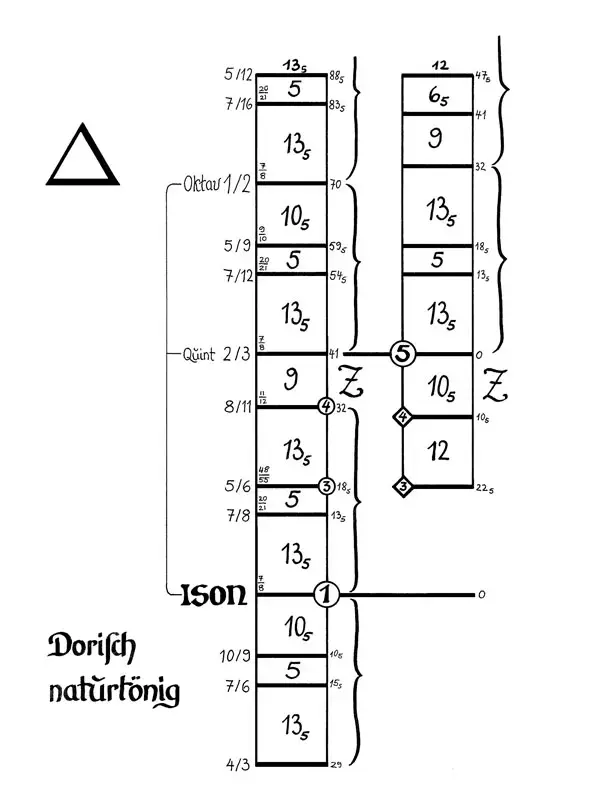
The foundation of harmonics is the natural lawfulness of the overtone series, which finds correspondence in the various realms of microcosm and macrocosm. Overtones are the partial vibrations that arise from a fundamental vibration, the fundamental tone. The overtone series develops in whole-number ratios. Thus every natural interval can be represented by a fraction with whole numbers. For music theory this fraction also forms the interval value of the corresponding tone distance or tone step.
The tables of the church modes contain, in addition to graphic presentation and the interval-width data, also the interval values, so that every scale degree, seen from the fundamental, can be mathematically determined and interpreted numerically and symbolically. For German Choral Chant, not least for reasons of number symbolism, a division of the octave into 70 Lütt was chosen.
When the singers sing in the corresponding fine tuning, the character of the individual church modes appears far more clearly than could ever be the case in tempered tuning. Since different triads arise on every scale degree, with sometimes differently wide fifths and different qualities of thirds, extraordinarily rich colour values arise. The chant may therefore at first sound unfamiliar, but ultimately one gains sounds of hyperborean clarity and power.
Learning the natural intervals requires some practice. As an aid we offer a calculation program (unfortunately only for Windows) with which one can calculate and hear natural intervals. It contains the above-mentioned list of natural scale degrees with explanatory notes, as well as tables with the scale degrees of all church modes and two tables for ear-training exercises. Alternatively, one can use the programs “Scala” or “Pianotec” and enter the corresponding values there. For further interest, one may contact the monks of the Holy Trinity Monastery.
Textbook
- Der Weg zum naturtönigen Kultgesang
- The musical system of German Orthodox church chant.
- The spiritual and historical prerequisites of German Orthodox church chant.
- The symbolism and harmonic structure of the overtones in German Orthodox church chant.