
Sacred Chant
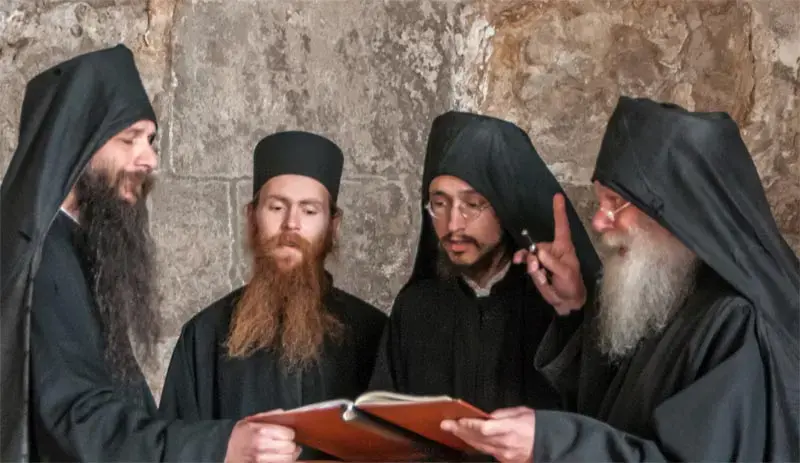
In Orthodox worship, chant is not a mere addition, but a necessary part of the divine theurgy. Especially in monasticism, it also serves as a spiritual exercise. Orthodox Christianity possesses a rich treasure of different chant traditions, which have developed according to the particular character of the respective languages and peoples.
The original Christian church chant is called “choral chant.” It arises from the word lifted up in prayer and borne by the Spirit. In Western Europe, one knows above all the Latin church chant of the Roman Church, Gregorian chant. An equally ancient and venerable choral tradition is Byzantine chant, which proceeds from the Greek language and is cultivated in the Greek Church. Most chant traditions of the Orthodox peoples go back to it. But there are also completely independent developments, such as the ancient three-part chant of the Georgian Orthodox Church or the younger polyphony in the Russian Church, different again in every respect (Rachmaninoff, Tchaikovsky, Bortniansky). The oldest form of Russian church chant is the Old Slavonic chant influenced by Byzantium and Bulgaria, also called “neumatic chant.” Romania has several chant forms side by side; several influences come together there, from Greek-Byzantine chant through Russian polyphony to folk-like formations in Transylvania. The corresponding chant tradition for Orthodox worship in the German language is German Choral Chant, as it is cultivated in the Holy Trinity Monastery.
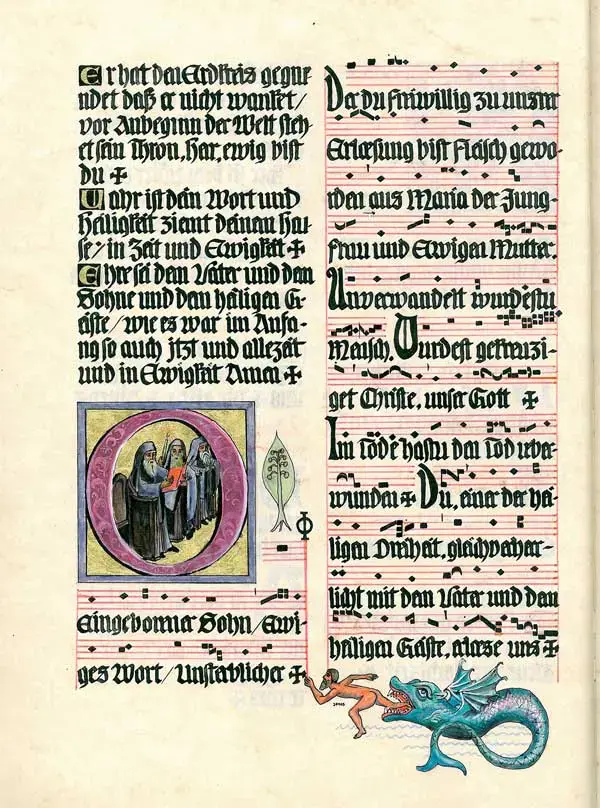
At the beginning of the 1980s, the first manuscripts for the German Orthodox daily office in a dedicated neumatic notation based on medieval models were created on the Holy Mountain Athos. This notation was further developed in the following years. In 1985, a first complete manuscript of the Divine Liturgy of Saint John Chrysostom in German Choral Chant was produced. This was followed, also in 1985, by the first printed edition, now out of print, the “Choir Book for the Divine Liturgy."
Today there is an extensive corpus with the ordinarium and the hymns of the great feasts, as well as models for stichody and psalmody. The art of improvisation is of no small importance, especially in the chanting of the proprium. The German or Greek text recited by the canonarch is rendered “ex tempore” in chant, while the singers must very carefully observe the prescribed church mode as well as the musical symbolism of the intervals and musical gestures (neumes).
The monks sing German Choral Chant in naturally tuned fine intonation, through which it gains a clarity and power all its own. There is also a textbook for this: Der Weg zum naturtönigen Kultgesang, as well as two documentation CDs on which psalmody, intercessions, syllabic and melismatic solo chant, and polyphonic hymns in all 8 church modes can be heard (see under ☞ Verlag).